


The Psychopath

Lindsay Clancy, in my opinion, did not want to kill herself. She wanted to kill her children.
It was all becoming too much for her, and she felt like she was drowning in it. Drowning in trying to be the perfect wife and the perfect mother. Her thoughts of suicide came as she tried to stop her thoughts of wanting to kill her children because what mother would ever think of doing such a thing?
That voice? That was her. That was her hatred bubbling up, especially for Dawson, the middle child. Her hatred at herself for not being the perfect mother, and the loud voice of her inner psychopath who gave her advice on how to end her misery. Kill them. That’s what you really want to do. Then, you can kill yourself.
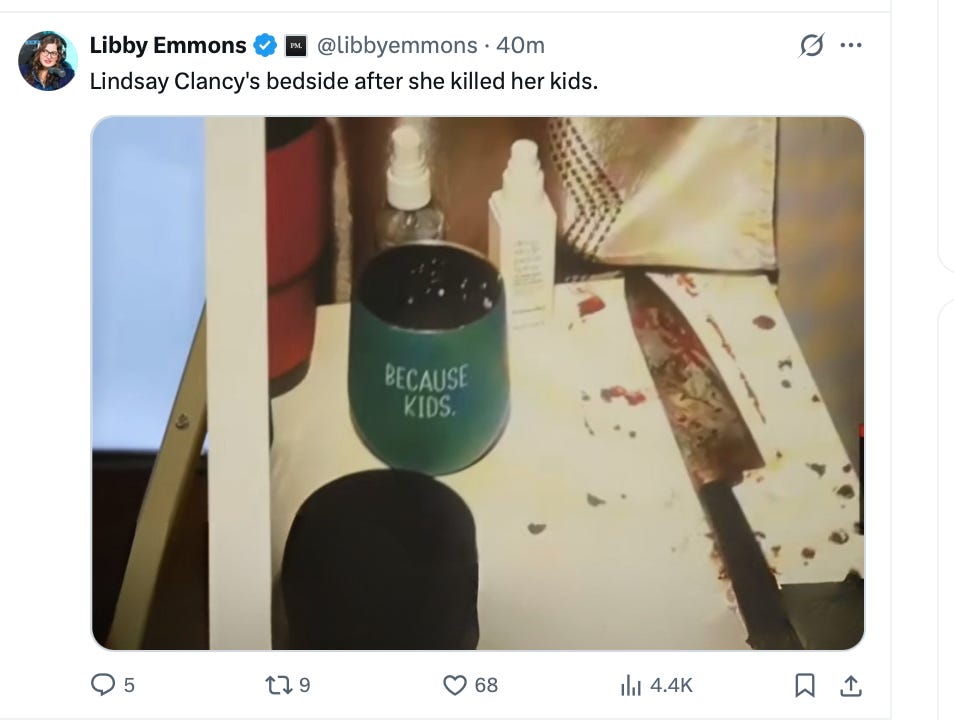
Except that she didn’t really want to kill herself. She is a nurse, after all, and everyone knows how to commit suicide by slitting your wrists. She would know exactly where the carotid artery was, oh, but that voice would tell her just make it look like that was what you were trying to do. Get enough blood to make it convincing, then crawl out the window and into the snow and wait for your husband Patrick to find you and save you.
What wasn’t in the plan? The way she fell, paralyzing herself, which is why these, along with whether she had a lawyer or not, were her primary concern once in the hospital. Do my legs work, she asked. The voice guided her through all of this and probably even through the trial now, careful never to disclose that it’s still with her. The camera is on you now, Lindsay. Put on a good show.
Maybe a part of her was sad to hear what the voice made her do, but she knew the voice was her own. It was the psychopath within that did not want to do the job of motherhood anymore. She wanted her old life back. She wanted to be who she was before. She wanted control. Her inner voice was herself.
She tried every medication she could. She tried aspirations. But the dark thoughts kept seeping through, no matter how much she tried to suppress them. She disclosed these thoughts to her husband and mother and hinted at them to her best friend.
What she never did was turn herself in for them as a danger to her own children. If the husband bears any responsibility for these deaths, it is that he did not turn her in himself and keep those precious babies far, far away from her.
On the day of the killings, Lindsey Clancy meticulously planned her actions, not as an irrational act but as a coldly rational one. Separating the children one by one and leading them down into the basement would have been scary for them, since it had never happened before. That was where Daddy worked. That was where Mommy worked out. That was where guests slept. It was not where kids belonged.
And that ominous walk down those stairs with Mommy must have been terrifying, but their little brains could not comprehend what would happen next.

Here is a clip from Chicks on the Right highlighting the prosecutor’s powerful closing.
The hope and the reflex is to blame the drugs. We’re a country of people on too many drugs, whether they’re dying on the streets of San Francisco of Fentanyl or they’re murdering their children in Massachusetts. One thing is for sure: lots of people are making lots of money selling the illusion that there is such a thing as being perfect.
I noticed this back in the 1990s when suddenly everyone had something wrong with their brains. We’d gone through therapy and healed the trauma and abuse in our past, but it didn’t make us “right” or “correct.” We needed drugs for that. We needed, wanted to be “healthy.”
We were the victims of our hard lives, of our society, of our government, of the environment, of our diet, of our education, our culture, our marriages, and yes, even our children.
Our children have paid the price, too, because if they weren’t perfect, something had to be wrong with them; we had done something bad or failed at motherhood. The mythical “post-partum” depression came on like one of these ailments in our brains we could do nothing about. We were all supposed to respect women who undergo this affliction and forgive them everything.
Over the many decades, especially on the Left, we’ve become separated from ourselves in nearly every way. Whether it’s mothers aborting their children now as a rite of passage and an act of empowerment, or it’s mothers resenting their children and unable to mother them with post-partum. Be afraid, they say, be very afraid.
And then, all the way down to our precious babies whose genders we now view as potentially “something wrong with their brains.” Mothers allow gender clinics, teachers, and influencers to tell them they don’t know their own babies. Drugs will fix them. Surgery, intervention, turn them into something else, someone else, someone more perfect.
Women did not evolve to do it all alone. We evolved to be hovered over by our own mothers, our aunts, our sisters. Since women had babies so young in every era except the modern one, they needed the help and guidance of older women, which is why humans are among the tiny handful of species that undergo menopause, like Killer Whales. Older women have a role: to guide, to lead, and to help raise the younger generations.


Lindsay Clancy wanted to do it all alone. Or at least, she wanted it to look like she did. An athlete, a nurse, and a mom, she wanted that Instagram fantasy all women believe they deserve. It all looked so good outwardly, from photos to testimonies of family and friends. But Lindsay was good at hiding. She was not a good mother at all, it turns out. She was a psychopath.
It isn’t that mothers don’t kill their babies. They do. They dump them in trash cans, leave them in toilets, beat them until they can no longer breathe. Andrea Yates believed her children were demons and that they needed to be killed. That is what true psychosis looks like, and it’s more common than it should be.
Women should not be doing motherhood alone, at least not those who are fragile enough to crack under pressure.
It’s not easy. It's shocking how difficult it can be just to try to live your life after you’ve had a baby, but it is especially so for the modern woman who is used to centering herself.
I was one such woman. By the time I had my baby at 32, I wanted her. She was a way for me to heal from my own childhood because I would do everything right.
My own mother got so angry at times she flew into violent rages. She had four babies before the age of 25, and that must have been hard. We were untamed, wild children, and she needed control. Even now, I sometimes feel nervous when I spend time with her because we never knew when the fury would arrive or why.
Like Lindsay, I was into the “attachment parenting” method, which is just the natural way women raised children before they invented things like cribs and formula. I didn’t want drugs during childbirth and wanted to do it all naturally. This is the kind of pressure women put on themselves to be perfect. If one thing goes wrong, they feel like a failure. And things will always go wrong. Breastfeeding them, co-sleeping with them, hugging them when they cry.
Lindsay felt guilt for not being the perfect attachment parent and leaving her baby to cry it out with sleep training. She couldn’t sleep, and this was supposedly the solution. But leaving babies to cry it out is another way to separate mothers from their natural instincts, and Lindsay knew that too. But if the baby went away, then the problems went away too.
After 18 hours of agonizing labor, I begged for the epidural. They’d already given me morphine, which did nothing. My labor was induced, and the contractions were unlike anything I’d ever felt in my life. The only thing I could do was scream. And when she finally came out of me, and I saw her face, I knew her already. I recognized her. My baby.
I kept yelling for the nurse, “Just give me my baby!” They wanted to clean her up and check her vitals, but I just wanted to hold her in my arms to keep her safe. When they finally gave her to me and when I was complaining that I had wanted to do it naturally, without drugs, the nurse looked at me and said, “Healthy mom, healthy baby.” She was right. That’s all that mattered.
That’s also the kind of thing labor and delivery nurses see all the time. They see the perfect and the imperfect. They see the joys and the tragedies. They see the struggles and failures. Lindsay Clancy knew all of them.
I didn’t let go of my baby for a full two weeks. She stayed in my arms and close to me at all times. I had nightmares of something happening to her — what would I do? If there was a fire, or an intruder, or an earthquake, or a mass shooter. I was raising her without a father, which made me both the father and the mother, and yes, that was hard. It meant my life would no longer be the most important thing.
Of course, I lost my temper on occasion. But I knew I would never be like my mom. I might have been if I’d had more than one. Children are their own people. They don’t do exactly what you want them to do at all times.
One of my jobs was writing movie reviews, and if my daughter didn’t go down for a nap, I couldn’t make the showtime, so I’d drive around until she did, and sometimes she didn’t, and I felt the pressure of that, and I would think and sometimes say, “time for sleep!”
The few times I lost my temper stay with me. They haunt me. I wish I could go back and scrub them from my memory and my life because I was, I think, all things considered, a pretty good mom otherwise. Perfect? No. And we all want to be perfect because if something is wrong with our kids, it means we weren’t perfect mothers.

I would hear the complaints of other mothers and their difficult children. Why couldn’t they behave? I saw them punish them with time-outs, and I always thought I was so lucky to have such a good kid. It was never bad for me. It was the best thing that’s ever happened in my life. So I can’t get there. I can’t imagine wanting a life without my daughter. My life is my daughter.
And this is what I think haunted Lindsay Clancy the most. She wasn’t a perfect mother because one of her kids was driving her crazy with his obstinacy. He was the middle child, Dawson. She loved the daughter and the baby, but Dawson did not do as he was told and made everything a battle.
When your life runs like clockwork and that life depends on everyone and everything doing things perfectly, one piece of the puzzle that keeps flying out of our hands is the one that will drive you to anger and, in her case, hopelessness. What was it all for anyway?
Of course she was depressed. Lots of people struggle with feeling lost and hopeless, but in Lindsay’s case, she believed she was disappearing because everyone’s needs had to come before hers. Unless, of course, she could get rid of the child, the one making the picture not perfect. But how could she just kill him? No, she’d have to kill them all and then kill herself, or at least make it look like she tried.
She wanted to terrorize her husband. And terrorize she did. The screams haven’t been heard by the watchers, all of those paying close attention to the trial at home. Only those in the room and the jury heard the husband’s anguished cries upon coming home and seeing his dead babies.
I studiously avoided the Lindsay Clancy trial. It was like those animal abuse videos you scroll quickly by or at least fast-forward to the inevitable happy ending, if there is one. I did not want to get inside this story or put the images of those poor, sweet children strangled one by one in my head.
But eventually, like everyone else, I had to pay attention to it. There were so many crazy women — mostly on the Left but some on the Right — who have stood alongside Lindsay, sympathized with her, celebrated her, attempted to say she wasn’t guilty, that her husband did it, the drugs did it, the doctors did it, everyone but Lindsay herself.
There is such a thing as post-partum depression, which can often lead to feelings of sadness and helplessness after the birth of the child. No one can or should tell a woman she isn’t suffering from it, but it’s also taken on a new meaning in our modern age, a thing that happens to women that they can’t control, separating us from our natural selves. A tragedy waiting for them on the other end of the line.
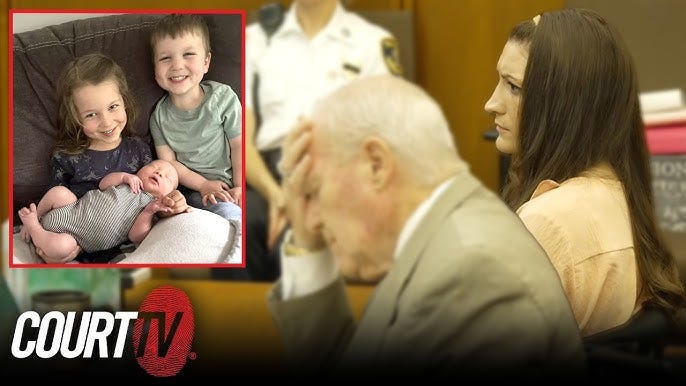
We don’t live in a society that wants us to care about the little life conceived. We live in a society that wants mothers to be victims and martyrs - not only their babies, but their husbands or men in general- are doing something bad to them. The baby grows and changes everything. The man injects the sperm. The woman must be the helpless, passive participant who takes care of everything.
That might not have been Lindsay Clancy, but her careful planning of how her husband would find his children and his wife by the time he came home required pre-meditation. She knew what those exercise bands could do, because, of course, she did. She worked out every day.
Did she think of what those bands would do every time she picked one up and felt the tension in her hands? What could this do to a child’s neck? How long would it take?
The Long Day
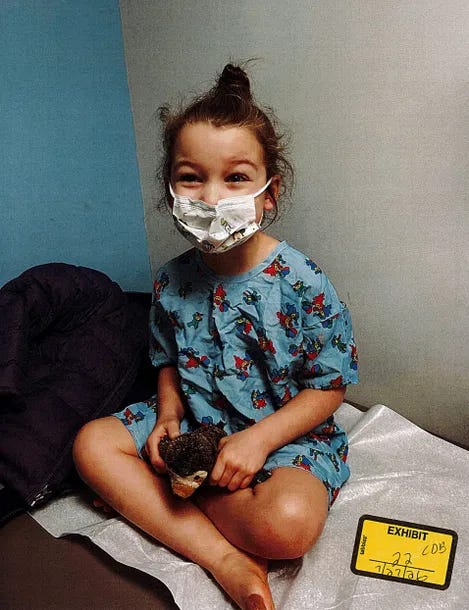
It was an ordinary day like any other. She’d taken her daughter to the doctor and texted Patrick, her husband, a photo of their daughter on the day she would murder her.
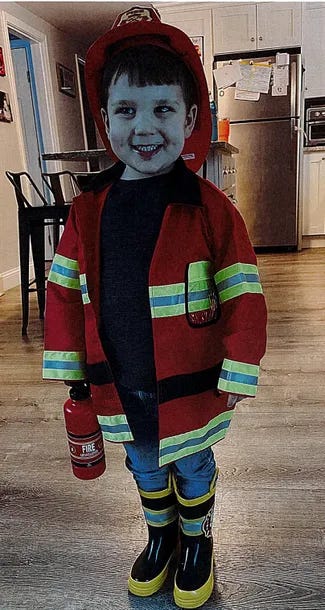
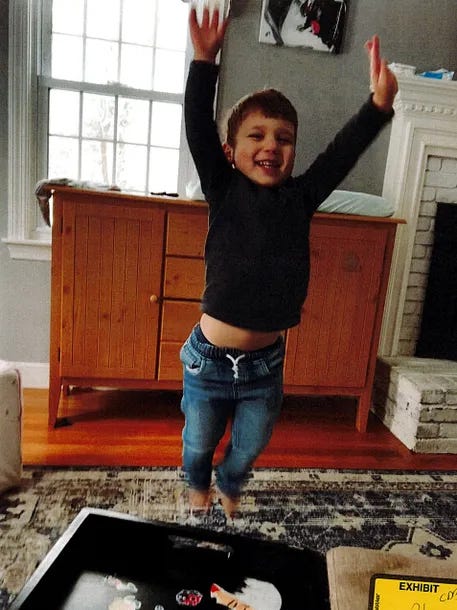
He texted her back a photo of Dawson, who had dressed himself for the first time. Did she think and wonder how Dawson could be so much better behaved with Daddy?
Lindsay came home with Cora, who was having stomach problems. She probably was picking up the stress of her mother’s bizarre flatness for some time before the murders. She was the oldest. She would know something was wrong.
Patrick went to work in his basement office as their smallest baby, Callan, went down for a nap. Lindsay built a snowman with Dawson and Cora. Did Dawson give her his usual trouble? Did he say something bad to her? Or was she planning this day all along?

By the time she got inside, she put her plan in motion. She texted her husband at 4:53 pm, “Any chance you want to do takeout from ThreeV … I didn’t cook anything … It’s been a long day.” She checked the map to see how long it would take him, and it wasn’t long enough, so she asked him to go to the drug store to pick up medicine for Cora.
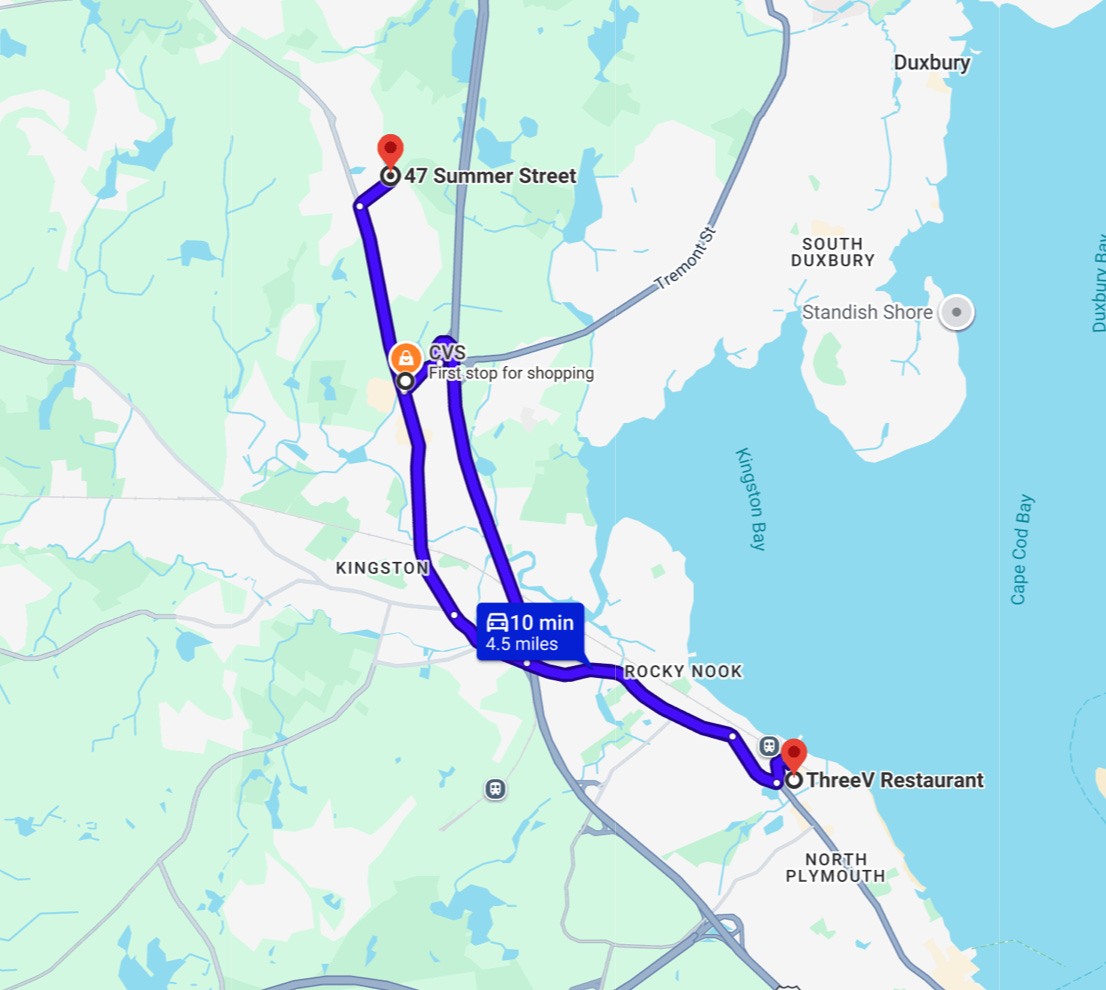
At 5:15 Patrick left, after kissing his daughter Cora and rocking his baby Callan, and said, “I’ll be right back.” That would be the last time he saw them alive. He’d be home by 6:09 pm and arrive to an absolutely quiet house.
Lindsey wanted him to call out for her and his children. She probably knew he’d go upstairs next. Maybe she thought he would just go to the basement and find his dead babies, with Dawson lying dead in his office.
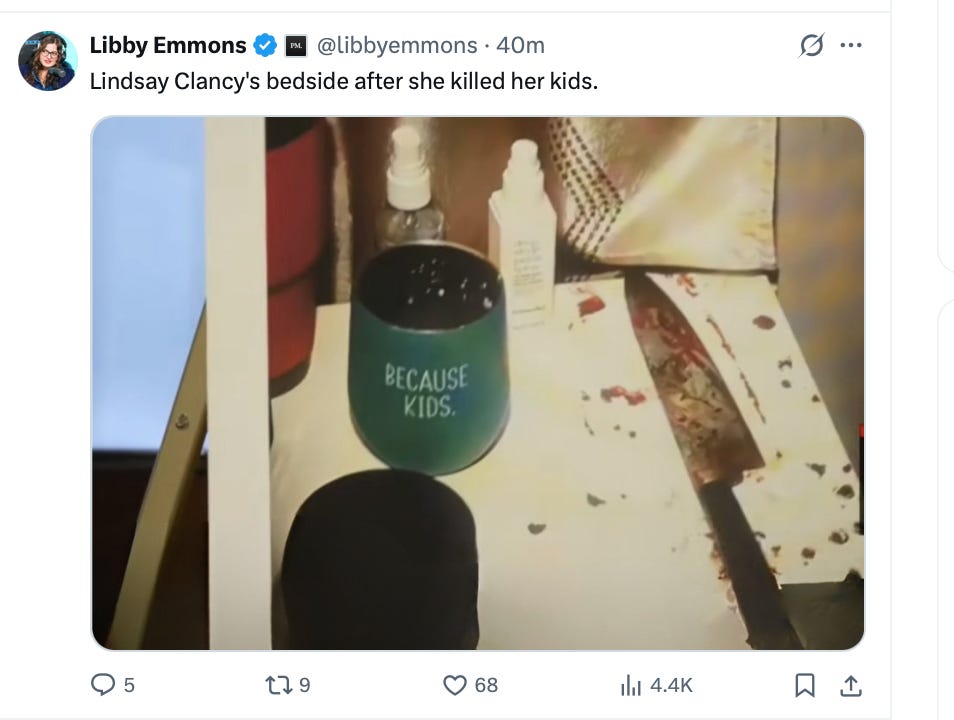
cBut he didn’t. He tried to find Lindsay. And when he saw the blood and the window and ran down to her where she was still alive, because of course she was, and asked her, “What did you do?” She said, “I tried to kill myself.”
All Lindsay said when he asked where the children were was, “They’re in the basement.” She wanted him to see that horror. Why?
Who does that? A psychopath does that. Not a woman suffering from post-partum depression. Not a woman in a state of confusion. No, a cold-blooded killer makes these choices to stage an event that would leave her children dead and herself barely alive but alive. A nurse who didn’t know how to properly cut her wrists or her throat?
She wanted to punish her husband. She wanted to punish everyone. She wanted to be free. She just didn’t think that would mean being in a wheelchair for the rest of her life. That was the unintended consequence of her plan.
The jury was excused for the weekend. I don’t expect this jury in Massachusetts, comprised mostly of women, will convict Lindsay Clancy of murder. That’s what she deserved. No, she’ll get off easier as some version of Not Guilty by reason of insanity. And that will be a lie.
Coming up, Part Two: The Sycophants
//


